yet another iterative root finding algorithm. Combination of Regula Falsi and Newton-Raphson
1. The Core Idea: Parabola, not a Line
-
Regula Falsi (False Position) approximates the function by drawing a line (a 1st-degree polynomial) through two points, and .
-
Newton-Raphson approximates the function by drawing a tangent line (also a 1st-degree polynomial) at one point, , using the derivative.
-
Müller’s Method takes this one step further. It approximates the function by drawing a parabola (a 2nd-degree polynomial, ) that passes through three initial points: , , and .
So,
-
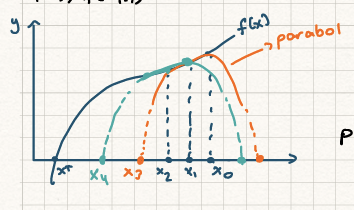
We start with three guesses: , , and .
-
We draw a unique parabola (the blue curve) that perfectly intersects (the orange curve) at all three of these points.
g(x0) = f(x0) and such.
-
A parabola can intersect the x-axis at zero, one, or two points. We find these intersections.
-
Our new guess, , is the intersection that is closest to our last guess ().
-
To find the next guess (), we would “forget” the oldest point () and repeat the process using the points .
The mathematics
The goal is to find the roots of the parabola as our new approximation.
Step 1: Define the Parabola in a Clever Way
Instead of the standard , the notes use a form centered around the most recent point, (in the graph’s first step, this would be ). This is Newton’s form of an interpolating polynomial:
This form is much easier to work with. We find the coefficients by forcing the parabola to pass through our three known points:
Plugging into the equation is very simple:
.
So, we instantly find .
We can then use the other two points to create a 2x2 system of equations to find and . The notes skip this algebra and just state, “Now we know coefficients.”
Step 2: Find the Zeros of the Parabola
We need to solve for our next guess, .
This is just a quadratic equation for the step size . Using the standard quadratic formula , we get:
Step 3: A More Numerically Stable Formula
The standard quadratic formula can be bad for computers. If is very large compared to , then . This means the numerator might become , a problem called catastrophic cancellation that destroys precision.
To fix this, the notes use a common trick: multiply the numerator and denominator by the conjugate (as noted by “eşlenik ile çarp”):
-
The numerator becomes:
-
The denominator becomes:
Canceling the term gives the new, more stable formula shown on the slide:
This formula has “two possibilities” (the ). The * note explains how to choose:
-
We pick the sign in the denominator () to be the same as the sign of . For example, if is positive, we use .
-
This forces the two terms in the denominator to add together, making the denominator’s magnitude as large as possible.
-
A larger denominator gives a smaller step size , which corresponds to the root of the parabola that is closest to our current guess .
3. Convergence
The final note, “The order of convergence is (konu dışı - off-topic),” is a key takeaway.
-
Regula Falsi is linear ().
-
Newton-Raphson is quadratic ().
-
Müller’s Method is superlinear ().
It is significantly faster than linear methods and, while not as fast as Newton’s method, it has a major advantage: you do not need to calculate the derivative , which can be difficult or impossible for some functions.